

CLICK ON THE IMAGERIES BELOW TO GET THEM ENLARGED

JTWC FACEBOOK
Joint Typhoon Warning Center
GTH Outlook Discussion
Last Updated - 04/21/26
Valid - 04/29/26 - 05/12/26
Earlier this month, constructive interference between the enhanced phase of the Madden-Julian Oscillation (MJO) and equatorial Rossby Wave (RW) activity over the western Pacific produced an exceptionally strong lower-level Westerly Wind Burst (WWB) event, and contributed to the development and intensification of Super Typhoon Sinlaku. Westerly wind episodes have been repetitious over the western Pacific this year, resulting in the development of very warm subsurface waters over the central and eastern Pacific via oceanic downwelling Kelvin wave activity. Thus, the latest WWB event is likely to reinforce and possibly strengthen much of the anomalously warm water volume in place over the equatorial Pacific, and aid in the favored transition from ENSO-neutral to El Nino conditions later this year.
In the wake of this tropical wave interaction over the Pacific, MJO activity has become increasingly organized. There is good consistency between both RMM and upper-level velocity potential observations featuring the enhanced (suppressed) phase of the MJO propagating eastward into the Western Hemisphere (Maritime Continent) while gaining amplitude during the past week. Dynamical models agree in continued eastward propagation of the MJO signal over the western Hemisphere, but vary in regards to its eventual strength and phasing during the next several weeks. The ECMWF remains the most robust and progressive with the MJO, with its bias-corrected RMM solutions favoring potentially strong MJO activity over the Indian Ocean and possibly reaching the Maritime Continent in May. In contrast, RMM forecasts from the GEFSv12 and CFSv2 favor a weaker and slower mean RMM solution while gravitating the signal more to the west. The struggle to gain RMM1 and propagate the signal eastward in these models may be explained by weaker convective responses over the Indian Ocean, as well as a greater potential for competing interference with an emerging low frequency lower-level westerly wind signal favored in the western Pacific. However, upper-level velocity potential forecasts from the GEFSv12 and CFSv2 reveal a healthier subseasonal outlook, as both maintain eastward propagating MJO activity in the objective wave filtering well into May. Therefore, the updated GTH outlook relies on subseasonal forcing, with added consideration of an emerging low frequency circulation favored over the western Pacific. Continued eastward propagation of the MJO would favor increased (decreased) chances for Tropical Cyclone (TC) development over the Indian Ocean (western Pacific) in the coming weeks. However, odds of formation in these areas look to be countered by a less active TC climatology in the southern Hemisphere, as well as the low frequency signal supportive of genesis in the western Pacific through early May.
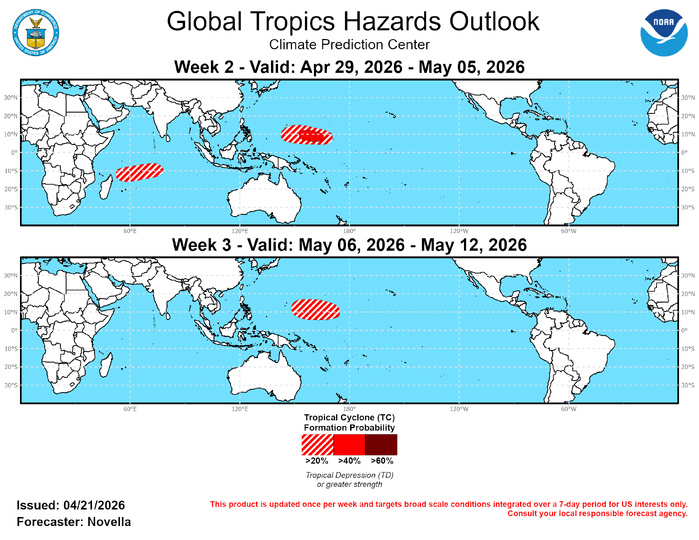
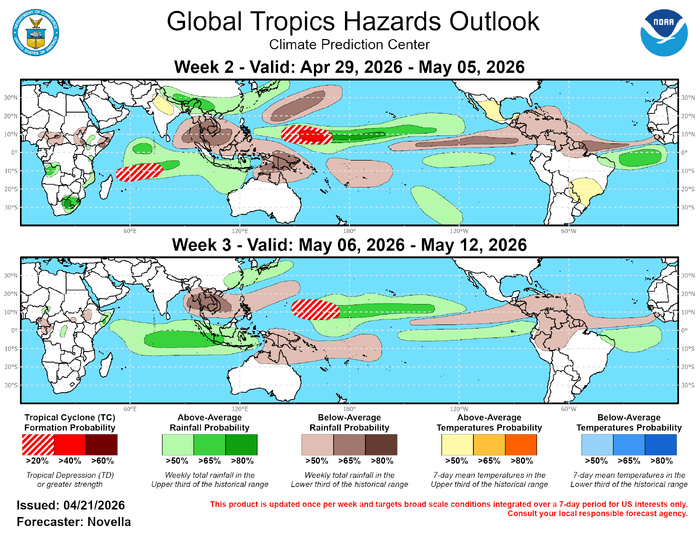
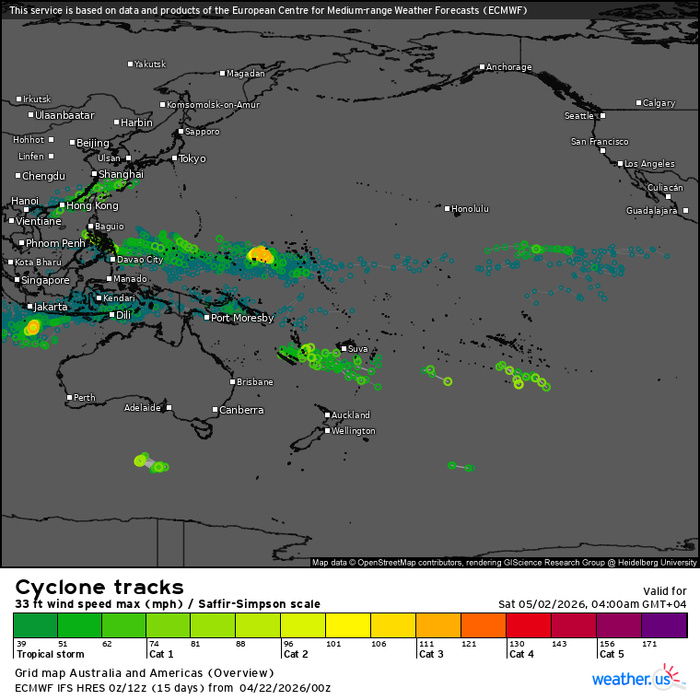
Since forming on 4/9, TC Sinlaku dissipated over the northern Pacific, with no new TC development during the past week. Looking ahead, chances for tropical cyclogenesis remain low during the week-1 period (consistent with a quiet April climatology), though probabilistic TC genesis tools continue to highlight a few areas for potential development towards the end of April. Tied to the lower-level westerly phase of the MJO shifting into the Indian Ocean, 20% chances for development are posted for week-2 from approximately 50E to 75E where ensemble solutions favor an area of mean low pressure with decreasing shear conditions. TC formation is also possible over the southeastern Indian Ocean during week-2 based on the tools, though higher shearing over this part of the basin looks to inhibit development and no corresponding areas are issued. In the western Pacific, guidance has been consistent in featuring elevated formation chances east of the Marianas tied to the aforementioned low frequency circulation consisting of a region of anomalous low-level westerlies, decreased shear, and enhanced divergence aloft. With additional support from AI tools favoring potential genesis in the wake of Sinlaku, 40% chances for TC development are also issued for week-2 near 160E where genesis signals are strongest, with a broader 20% area from approximately 140E to 170E. With these favorable environmental conditions expected to persist later in May based on CFSv2, GEFS ,and ECMWF extended range guidance, 20% chances of TC development for this part of the basin for week-3.
Joint Typhoon Warning Center
GTH Outlook Discussion
Last Updated - 04/21/26
Valid - 04/29/26 - 05/12/26
Earlier this month, constructive interference between the enhanced phase of the Madden-Julian Oscillation (MJO) and equatorial Rossby Wave (RW) activity over the western Pacific produced an exceptionally strong lower-level Westerly Wind Burst (WWB) event, and contributed to the development and intensification of Super Typhoon Sinlaku. Westerly wind episodes have been repetitious over the western Pacific this year, resulting in the development of very warm subsurface waters over the central and eastern Pacific via oceanic downwelling Kelvin wave activity. Thus, the latest WWB event is likely to reinforce and possibly strengthen much of the anomalously warm water volume in place over the equatorial Pacific, and aid in the favored transition from ENSO-neutral to El Nino conditions later this year.
In the wake of this tropical wave interaction over the Pacific, MJO activity has become increasingly organized. There is good consistency between both RMM and upper-level velocity potential observations featuring the enhanced (suppressed) phase of the MJO propagating eastward into the Western Hemisphere (Maritime Continent) while gaining amplitude during the past week. Dynamical models agree in continued eastward propagation of the MJO signal over the western Hemisphere, but vary in regards to its eventual strength and phasing during the next several weeks. The ECMWF remains the most robust and progressive with the MJO, with its bias-corrected RMM solutions favoring potentially strong MJO activity over the Indian Ocean and possibly reaching the Maritime Continent in May. In contrast, RMM forecasts from the GEFSv12 and CFSv2 favor a weaker and slower mean RMM solution while gravitating the signal more to the west. The struggle to gain RMM1 and propagate the signal eastward in these models may be explained by weaker convective responses over the Indian Ocean, as well as a greater potential for competing interference with an emerging low frequency lower-level westerly wind signal favored in the western Pacific. However, upper-level velocity potential forecasts from the GEFSv12 and CFSv2 reveal a healthier subseasonal outlook, as both maintain eastward propagating MJO activity in the objective wave filtering well into May. Therefore, the updated GTH outlook relies on subseasonal forcing, with added consideration of an emerging low frequency circulation favored over the western Pacific. Continued eastward propagation of the MJO would favor increased (decreased) chances for Tropical Cyclone (TC) development over the Indian Ocean (western Pacific) in the coming weeks. However, odds of formation in these areas look to be countered by a less active TC climatology in the southern Hemisphere, as well as the low frequency signal supportive of genesis in the western Pacific through early May.
Since forming on 4/9, TC Sinlaku dissipated over the northern Pacific, with no new TC development during the past week. Looking ahead, chances for tropical cyclogenesis remain low during the week-1 period (consistent with a quiet April climatology), though probabilistic TC genesis tools continue to highlight a few areas for potential development towards the end of April. Tied to the lower-level westerly phase of the MJO shifting into the Indian Ocean, 20% chances for development are posted for week-2 from approximately 50E to 75E where ensemble solutions favor an area of mean low pressure with decreasing shear conditions. TC formation is also possible over the southeastern Indian Ocean during week-2 based on the tools, though higher shearing over this part of the basin looks to inhibit development and no corresponding areas are issued. In the western Pacific, guidance has been consistent in featuring elevated formation chances east of the Marianas tied to the aforementioned low frequency circulation consisting of a region of anomalous low-level westerlies, decreased shear, and enhanced divergence aloft. With additional support from AI tools favoring potential genesis in the wake of Sinlaku, 40% chances for TC development are also issued for week-2 near 160E where genesis signals are strongest, with a broader 20% area from approximately 140E to 170E. With these favorable environmental conditions expected to persist later in May based on CFSv2, GEFS ,and ECMWF extended range guidance, 20% chances of TC development for this part of the basin for week-3.

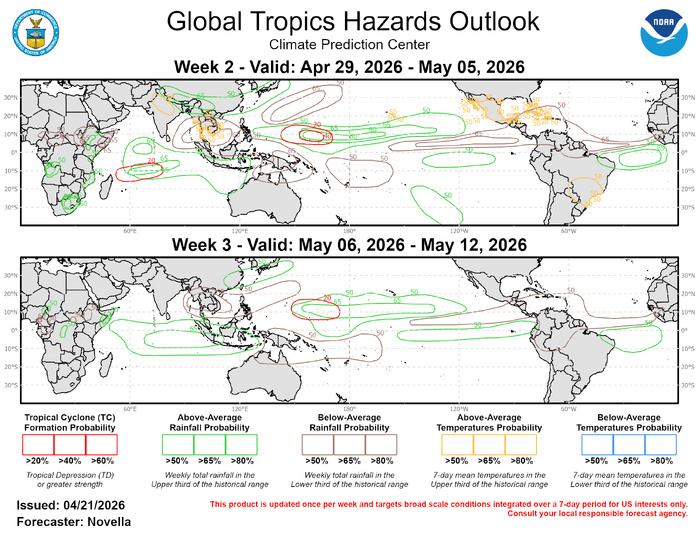
The precipitation outlooks for weeks 2 and 3 is based on a skill weighted blend of CFSv2, GEFSv12, and ECMWF ensemble forecasts, historical composites of Western Hemisphere and Indian Ocean MJO events, and the low frequency signal favored in the equatorial Pacific. For temperatures, above-normal, but non hazardous conditions are favored for portions of the southern tier of the contiguous U.S. (CONUS), Mexico, Hawaii, and portions of southeastern Brazil. Potential excessive heat conditions, with increased chances for daytime temperature exceeding 100 deg F are predicted for portions of northern India, and Pakistan, and portions of southeastern Asia during week-2. For hazardous weather concerns in your area during the next two weeks, please refer to your local NWS office, the Medium Range Hazards Forecast from the Weather Prediction Center (WPC), and the CPC Week-2 Hazards Outlook. Forecasts issued over Africa are made in coordination with the International Desk at CPC.

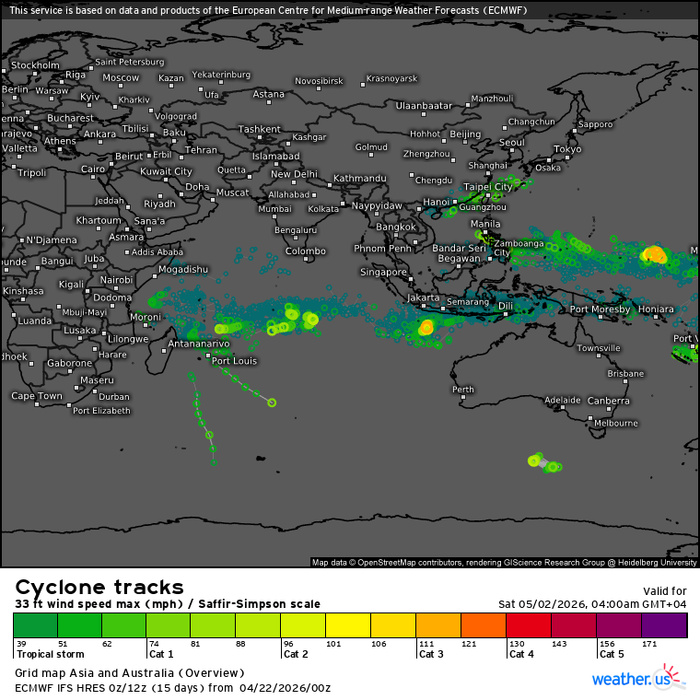
ECMWF IFS HRES MODEL RUN 04/22/2026 0000 UTC VALID FOR + 240h

ECMWF IFS HRES MODEL RUN 04/22/2026 0000 UTC VALID FOR + 240h