

JTWC FACEBOOK
Joint Typhoon Warning Center
GTH Outlook Discussion
Last Updated - 04/28/26
Valid - 05/06/26 - 05/19/26
Both RMM and upper-level velocity potential observations continue to show a well organized MJO, with its enhanced phase propagating eastward over Africa while maintaining a high amplitude during the past week. Dynamical models are in agreement favoring continued MJO activity over the Indian Ocean initially, then a quick drop in the RMM signal as the MJO moves into the Maritime Continent. Other modes of tropical variability remain in play, such as Rossby waves and emerging low-frequency forcing as the central and eastern tropical Pacific continue to warm ahead of an anticipated El Nino event. Earlier this month, constructive interference between the MJO and equatorial Rossby wave activity led to an exceptionally strong Westerly Wind Burst (WWB) event over the western Pacific, contributing to the development and intensification of Super Typhoon Sinlaku. Additionally, this WWB event, and continued oceanic downwelling Kelvin wave activity is likely to reinforce and/or strengthen an anomalously warm subsurface volume and aid in the favored transition to El Nino in the coming months.
No tropical cyclones (TCs) formed over the last week.
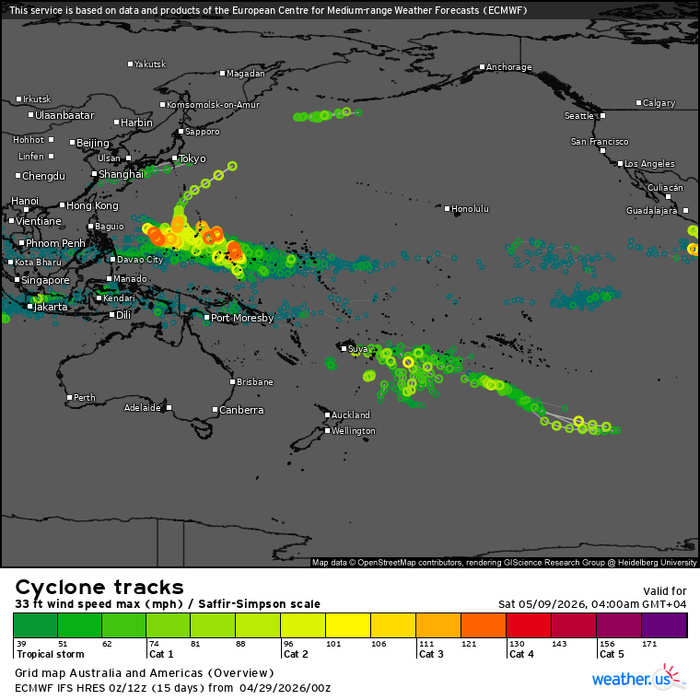
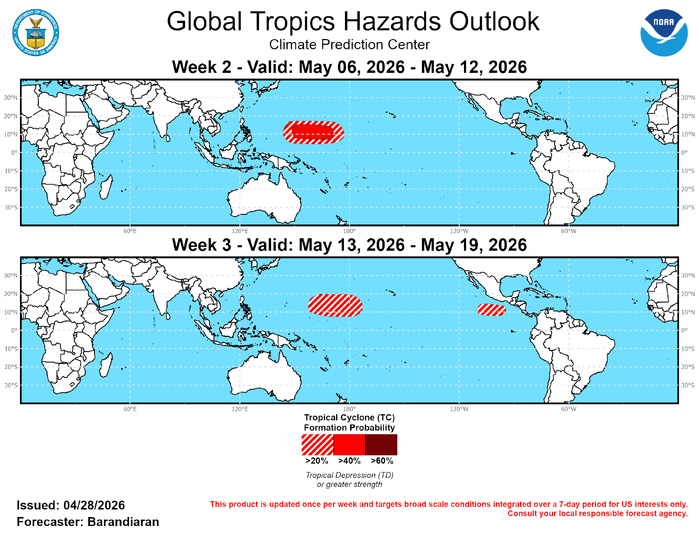
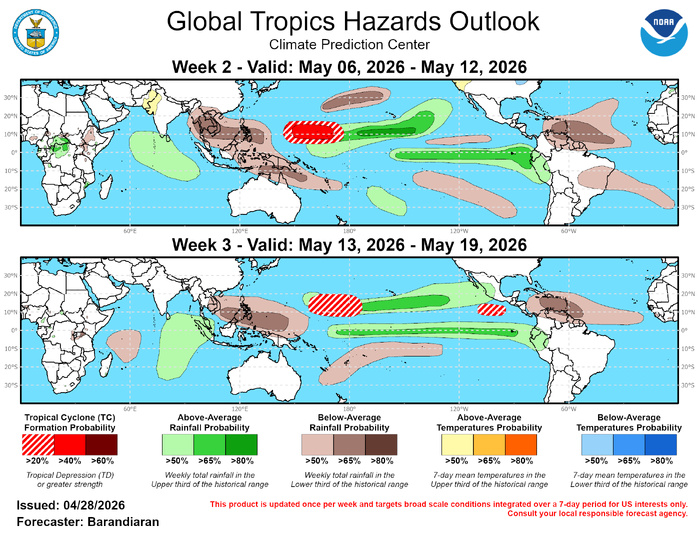
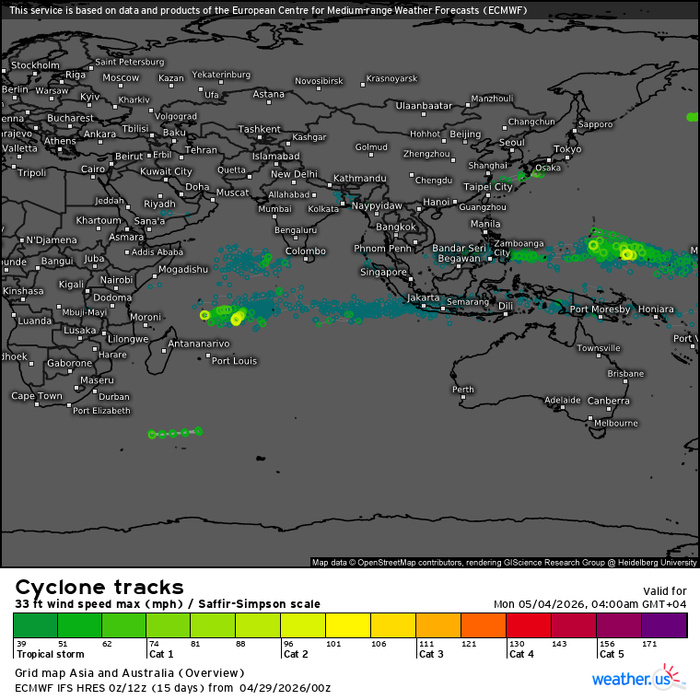
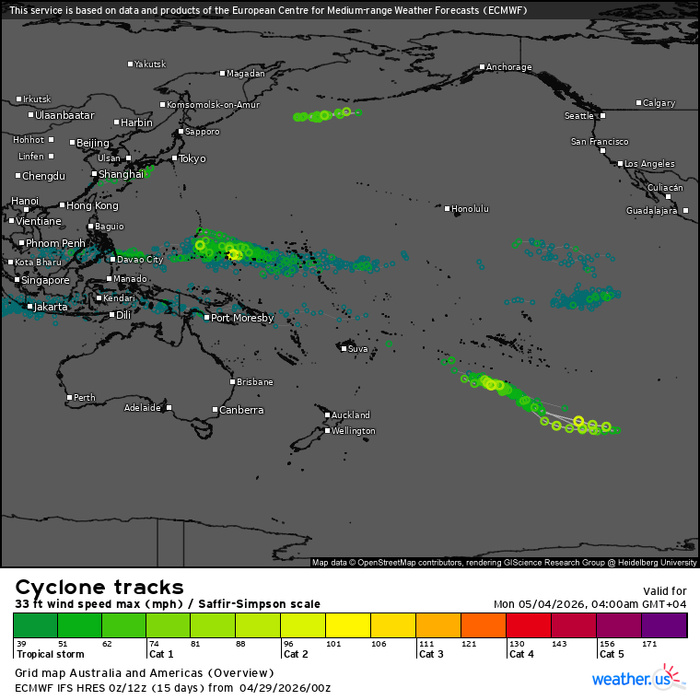
With the MJO favored to be somewhere near the Maritime Continent/Western Pacific and widespread anomalously warm surface waters, conditions are quite favorable for TC genesis in the Western Pacific throughout the forecast period. This is reflected among a variety of forecast tools. The probabilistic ECMWF extended range TC activity tool indicates chances exceeding 50% east of the Mariana Islands during week-2. Google’s AI TC tool also shows a cluster of potential tropical lows spinning up in the Western Pacific right around the beginning of week-2, and CPC's probabilistic TC tool also highlights the area east of the Marianas for potential TC genesis. Given all this, a moderate chance (40-60%) of TC genesis is posted for the Western Pacific east of the Marianas Island, along with a slight chance (20-40%) of TC genesis extending eastward to near the Date Line. Many islands in the region endured moderate to severe damage from the passage of Typhoon Sinlaku, so additional TC activity in the region would exacerbate conditions on the ground.
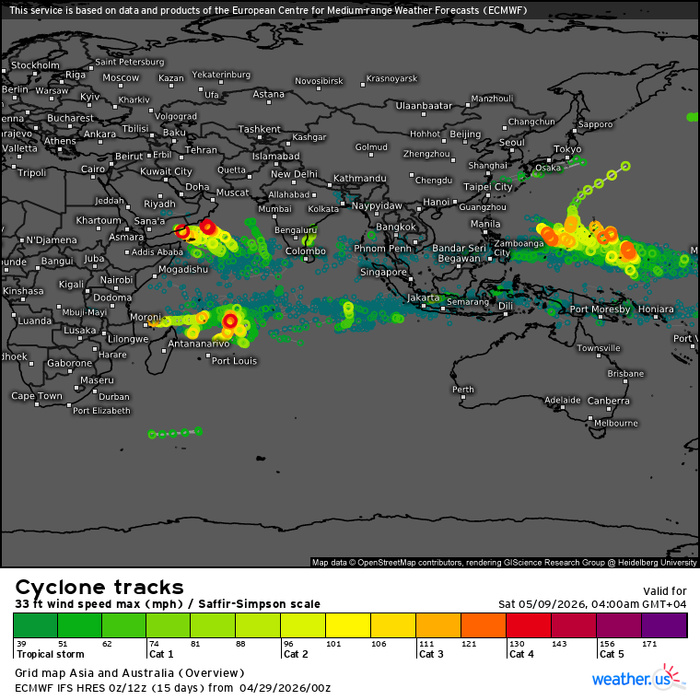
The chances of TC development for the Western Pacific extend into the week-3 period as well, although signal strength is lower among forecast guidance. For week-3 a slight chance of TC genesis is posted, slightly shifted eastward relative to the area highlighted for week-2. Also in week-3 models depict a rapid spread of enhanced divergence aloft associated with MJO activity into the Eastern Pacific,where surface waters are also quite warm. Ensemble member MSLP plots from both the GEFS and ECENS depict a number of tropical lows being spun up by ensemble members, and CPC's TC genesis tool also highlights the Eastern Pacific with modest chances (~20%) of TC genesis off the Pacific coast of Mexico. Therefore a slight chance of TC genesis is posted for week-3.
Joint Typhoon Warning Center
GTH Outlook Discussion
Last Updated - 04/28/26
Valid - 05/06/26 - 05/19/26
Both RMM and upper-level velocity potential observations continue to show a well organized MJO, with its enhanced phase propagating eastward over Africa while maintaining a high amplitude during the past week. Dynamical models are in agreement favoring continued MJO activity over the Indian Ocean initially, then a quick drop in the RMM signal as the MJO moves into the Maritime Continent. Other modes of tropical variability remain in play, such as Rossby waves and emerging low-frequency forcing as the central and eastern tropical Pacific continue to warm ahead of an anticipated El Nino event. Earlier this month, constructive interference between the MJO and equatorial Rossby wave activity led to an exceptionally strong Westerly Wind Burst (WWB) event over the western Pacific, contributing to the development and intensification of Super Typhoon Sinlaku. Additionally, this WWB event, and continued oceanic downwelling Kelvin wave activity is likely to reinforce and/or strengthen an anomalously warm subsurface volume and aid in the favored transition to El Nino in the coming months.
No tropical cyclones (TCs) formed over the last week.
With the MJO favored to be somewhere near the Maritime Continent/Western Pacific and widespread anomalously warm surface waters, conditions are quite favorable for TC genesis in the Western Pacific throughout the forecast period. This is reflected among a variety of forecast tools. The probabilistic ECMWF extended range TC activity tool indicates chances exceeding 50% east of the Mariana Islands during week-2. Google’s AI TC tool also shows a cluster of potential tropical lows spinning up in the Western Pacific right around the beginning of week-2, and CPC's probabilistic TC tool also highlights the area east of the Marianas for potential TC genesis. Given all this, a moderate chance (40-60%) of TC genesis is posted for the Western Pacific east of the Marianas Island, along with a slight chance (20-40%) of TC genesis extending eastward to near the Date Line. Many islands in the region endured moderate to severe damage from the passage of Typhoon Sinlaku, so additional TC activity in the region would exacerbate conditions on the ground.
The chances of TC development for the Western Pacific extend into the week-3 period as well, although signal strength is lower among forecast guidance. For week-3 a slight chance of TC genesis is posted, slightly shifted eastward relative to the area highlighted for week-2. Also in week-3 models depict a rapid spread of enhanced divergence aloft associated with MJO activity into the Eastern Pacific,where surface waters are also quite warm. Ensemble member MSLP plots from both the GEFS and ECENS depict a number of tropical lows being spun up by ensemble members, and CPC's TC genesis tool also highlights the Eastern Pacific with modest chances (~20%) of TC genesis off the Pacific coast of Mexico. Therefore a slight chance of TC genesis is posted for week-3.

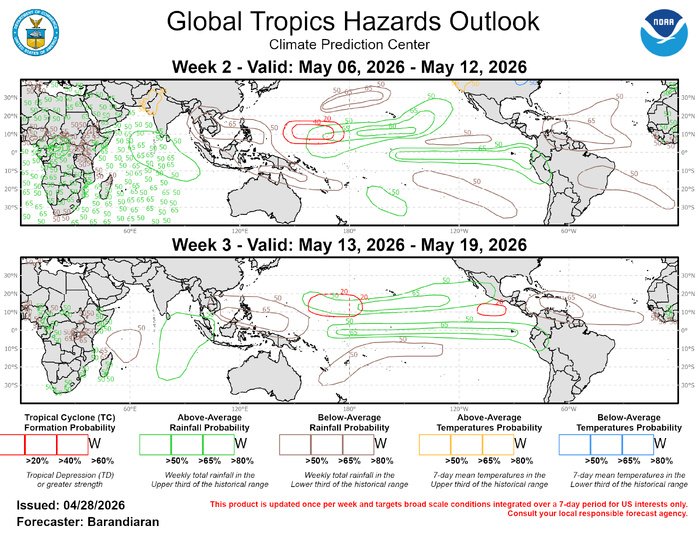
The precipitation outlook for weeks 2 and 3 is based on potential TC activity, the anticipated low frequency response, MJO composites, and informed by GEFS, CFS, Canadian, and ECMWF ensemble mean solutions. Above-normal temperatures are favored for portions of the western U.S, as well as portions of Pakistan and India, while below-normal temperatures are likely for portions of the Ohio Valley in the U.S. For hazardous weather conditions in your area during the coming two-week period, please refer to your local NWS office, the Medium Range Hazards Forecast produced by the Weather Prediction Center, and the CPC Week-2 Hazards Outlook. Forecasts made over Africa are made in coordination with the International Desk at CPC.

ECMWF IFS HRES MODEL RUN 04/29/2026 0000 UTC VALID FOR + 120h

ECMWF IFS HRES MODEL RUN 04/29/2026 0000 UTC VALID FOR + 120h

ECMWF IFS HRES MODEL RUN 04/29/2026 0000 UTC VALID FOR + 240h

ECMWF IFS HRES MODEL RUN 04/29/2026 0000 UTC VALID FOR + 240h