

CLICK ON THE IMAGERIES BELOW TO GET THEM ENLARGED


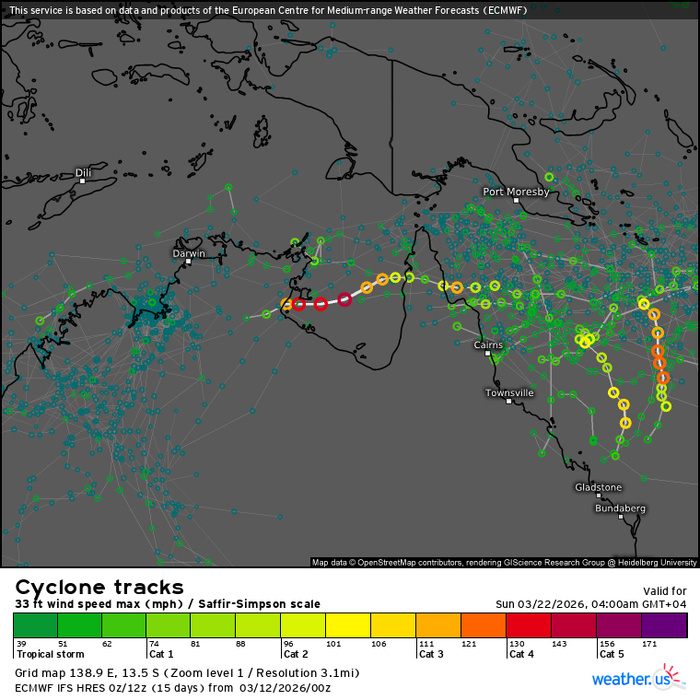
GTH Outlook Discussion Last Updated - 03/10/26 Valid - 03/18/26 - 03/31/26 Global circulation patterns in the global tropics continue to undergo complex evolutions as frequent equatorial Rossby waves have been emerging over the Central Pacific, resulting in rounds of interference with any MJO activity traversing the globe. Over the last week the enhanced phase of the MJO has once again stalled over the Maritime Continent in the wake of a Rossby wave interaction, potentially driving the rash of tropical cyclones (TCs) that have emerged in the Australia region over the last week or so. RMM forecasts depict another potential stalling of the MJO during the forecast period, as the enhanced phase shifts into the Western Hemisphere. The Coral Sea continues to be a hot-spot for enhanced TC activity during the week 2-3 period. Three TCs formed over the last week. On March 4, TC 25S formed in the Timor Sea several hundred miles south of Java. 25S quickly encountered unfavorable conditions and dissipated the following day. Also on March 4, TC 24P formed in the Coral Sea several hundred miles northeast of Queensland city of Port Douglas. 24P tracked southwestward and dissipated after making landfall south of Port Douglas on March 6. On March 6, TC 26S formed in the Timor Sea, very near where 25S had formed just two days prior. Like 25S, 26S encountered unfavorable conditions for further development and dissipated after tracking west into the open Indian Ocean. Additionally, the Joint Typhoon Warning Center (JTWC) is monitoring an area designated 95W just north of Yap in the Philippine Sea, with TC genesis likely within the next 24hrs. Current guidance indicates a northwesterly track in the coming days. For the latest on 95W please refer to the JTWC. The MJO is favored to be in phase 7-8 during the forecast period, which would tend to favor TC development along the northern coast of Australia and South Pacific. Model guidance is supportive of this possibility, with the ECMWF in particular indicating >40% chances of TC activity over the Coral Sea during the forecast period. The GEFS and Google AI models are not as robust but still indicate increased chances of TC activity through week-2 and into week-3. MJO phasing is also favorable along the northern coast of Australia, which is similarly reflected in model guidance. In week-2 a slight chance (20-40% probability) of TC genesis is indicated from the Timor Sea eastward to New Caledonia, along with a moderate probability (40-60%) covering much of the Coral Sea. Guidance from the ECMWF and Google AI models also indicate the potential for TC activity near Madagascar late in week-1 and possibly into week-2, which would be consistent with the suppressed phase of the MJO moving away from the East African coast. Therefore a slight chance of TC genesis is posted for the Mozambique Channel and the south Indian Ocean near Madagascar for week-2. In week-3 models tend to focus potential TC activity more tightly on the northeastern coast of Australia, and a continued potential for TC activity east of Madagascar as the MJO�s suppressed phase shifts eastward. However, model guidance is less bullish in week-3 than in week-2 across the Southern Hemisphere, leading to a more conservative forecast. A slight chance for TC genesis (20-40%) is posted covering the Gulf of Carpentaria and eastward towards New Caledonia, with no areas highlighted in the Indian Ocean.


The precipitation outlook for weeks 2 and 3 is based on potential TC activity, the anticipated low frequency response, MJO composites, and informed by GEFS, CFS, Canadian, and ECMWF ensemble mean solutions. Above-normal, but non hazardous temperatures are indicated for much of the southern Contiguous U.S. and Mexico during week-2. For hazardous weather conditions in your area during the coming two-week period, please refer to your local NWS office, the Medium Range Hazards Forecast produced by the Weather Prediction Center, and the CPC Week-2 Hazards Outlook. Forecasts made over Africa are made in coordination with the International Desk at CPC.


ECMWF IFS HRES MODEL RUN 03/12/2026 0000 UTC VALID FOR + 120h

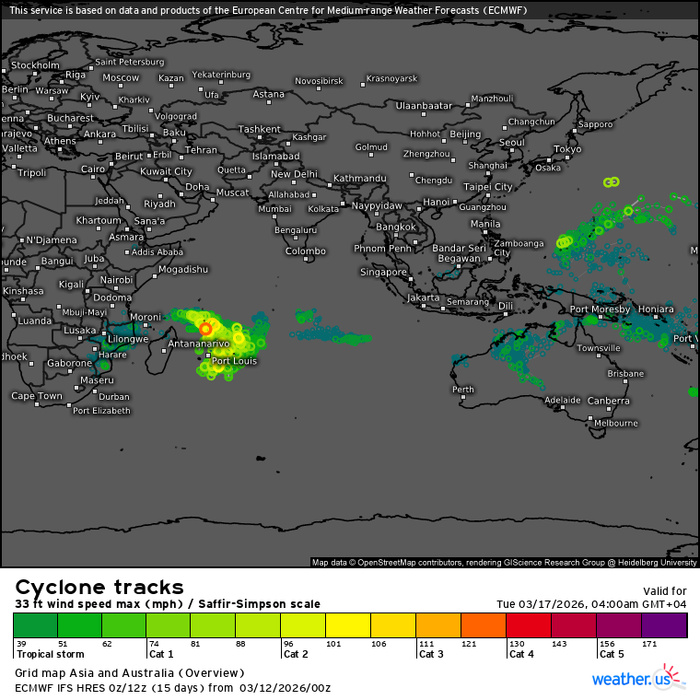
ECMWF IFS HRES MODEL RUN 03/12/2026 0000 UTC VALID FOR + 240h


AREA UNDER WATCH 03/12/2026 0000 UTC VALID FOR + 240h


ECMWF IFS HRES MODEL RUN 03/12/2026 0000 UTC VALID FOR + 120h


ECMWF IFS HRES MODEL RUN 03/12/2026 0000 UTC VALID FOR + 240h

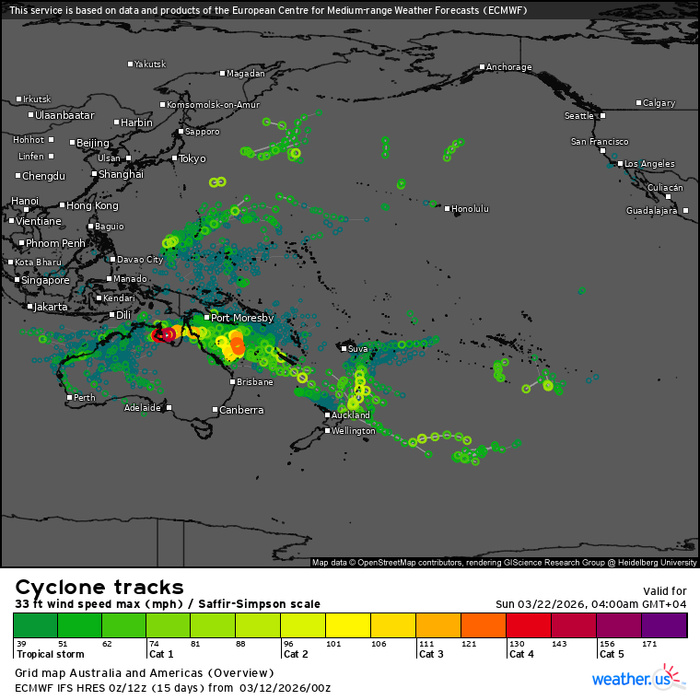
AREA UNDER WATCH 03/12/2026 0000 UTC VALID FOR + 240h