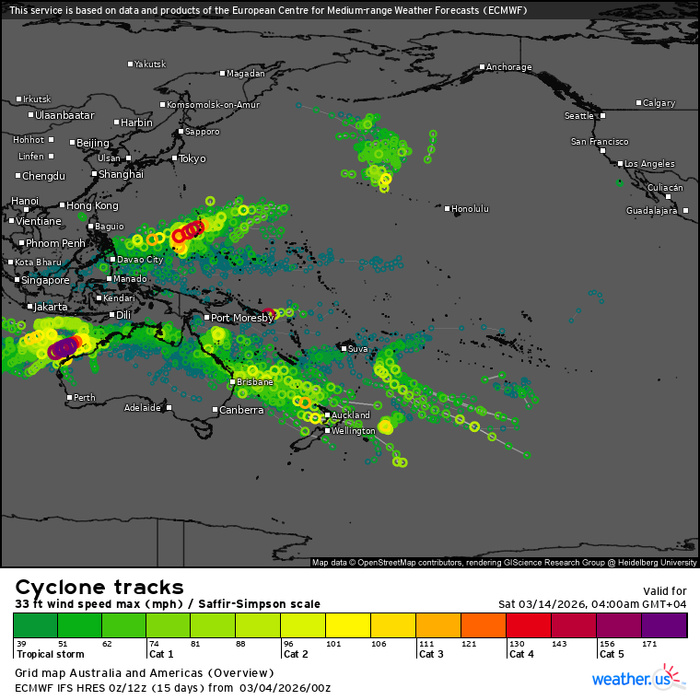


CLICK ON THE IMAGERIES BELOW TO GET THEM ENLARGED


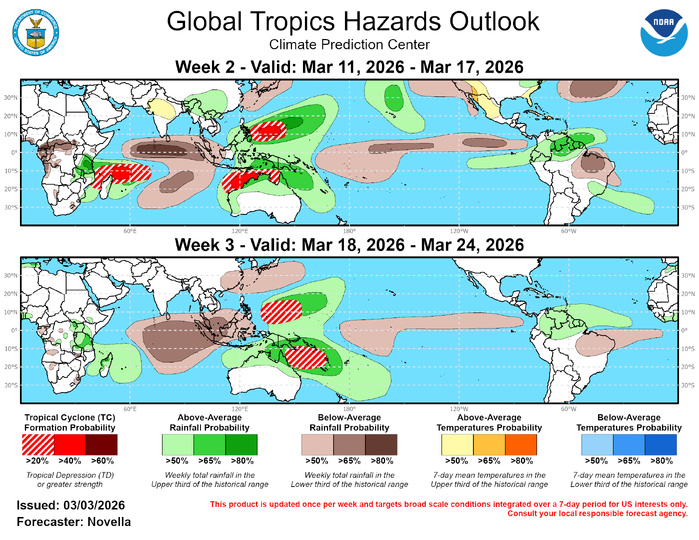
GTH Outlook Discussion Last Updated - 03/03/26 Valid - 03/11/26 - 03/24/26 The MJO became more coherent during the past week. Based on the latest observations, both the enhanced and suppressed upper-level divergence envelopes grew more robust with stronger convection overspreading the Maritime Continent. A more canonical eastward propagation is also present in the RMM index, where the signal recently entered phase 5. Based on objective wave filtering, this reorganization looks to be aided by both constructively interfering wave-2 equatorial Kelvin Wave (KW) activity, as well as an equatorial Rossby Wave (RW) propagating westward from the western Pacific. In addition, renewed MJO activity also looks to have abetted the residual La Nina circulation, however continued warming of oceanic surface and subsurface temperatures throughout the equatorial Pacific remain suggestive of the transition to ENSO-neutral conditions heading into boreal spring. Looking ahead, dynamical models favor some eastward propagation of the MJO, but guidance converges on a westward retreat and deamplication of the signal in the near-term. This behavior appears tied to the aforementioned RW shifting westward into the Indian Ocean, with its suppressed phase limiting the eastward expansion of MJO-related enhanced convection and lower level westerly anomalies over the western Pacific. It is worth noting that competing RW interference with the MJO has been a recurring theme since earlier this year, but in each of these instances where the MJO signal has stalled and/or weakened, the MJO has managed to eventually regain its strength and resume eastward propagation based on RMM observations. There is some support for a reorganizing MJO, namely in the GEFS based forecasts which favor a strengthening signal over the Western Pacific during weeks 2 and 3. By contrast however, the ECMWF based RMM forecasts have been consistent in keeping a much weaker mean MJO signal at these forecast leads. A plausible explanation for the weakened MJO in the ECMWF is the potential for stronger KW activity in the model. As this faster moving wave mode moves out ahead of the slower main convective MJO envelope, there is the potential for additional destructive interference with the MJO which is reflected in the ECMWF upper-level velocity potential anomaly forecasts depicting a more disorganized pattern by mid-March. Later in March, though, these forecasts do reveal a slower moving divergence envelope remaining intact. Given that strong background easterlies have been observed aloft over the Maritime Continent, such headwinds could be leading to this slowdown, and an active MJO cannot be ruled out. Taken all together, the updated outlook considers subseasonal forcing in conjunction with the dynamical model ensemble guidance, with less reliance on the MJO due to increased uncertainty in regards to its strength in the longer leads. One TC developed in the global tropics during the past week. TC Urmil formed on Feb 26 near 18S/168E less than 100 miles south of Port Vila, Vanuatu. This system peaked at Category 1 strength while tracking southeastward across the southern Vanuatu islands. Urmil eventually succumbed to a high shear environment and underwent extratropical transition a few days ago. As previously forecast, conditions look to be primed for TC development mainly to the north of Australia during week-1. The Joint Typhoon Warning Center (JTWC) is currently highlighting four Invest areas with two in the southeastern Indian Ocean (90S and 93S), one near the Gulf of Carpentaria (92P), and one in the Coral Sea (91P), all with increasing chances for development over the next several days. In the wake of these potential systems, the large-scale environment looks to remain favorable for additional development to the north of Australia. Based on agreement between the ECMWF and Google AI solutions favoring a regeneration of TC genesis signals over the Timor Sea, 40% chances are posted in the week-2 outlook, with a broader 20% area extending eastward to the Gulf of Carpentaria. Additional TC development is also possible in the Coral Sea, however, much of the MJO-related anomalous lower-level westerlies look to be displaced too far south during week-2. With less cyclonic flow, higher shear, and modest support from the tools, this precludes a TC area in the basin. Despite the suppressed phase of the MJO establishing itself over the Indian Ocean, probabilistic TC genesis tools have been consistent in their depiction of elevated chances to the south of the equator from 40E to 70E, which appears to be tied to equatorial RW activity inducing more anomalous lower-level westerlies in the region. 40% chances are posted to the northeast of Madagascar where tools show the strongest signals in the basin, with a broad 20% area extending from the Mozambique Channel eastward to approximately 70E. North of the equator, there is also continued support from the ensembles and probabilistic tools for development in the West Pacific. While most deterministic solutions have formed closed lows in the basin late in week-1, there is a good deal of spread in the ensemble guidance, implying the potential for delayed formation. Based on a strengthening of anomalous lower-level westerlies in the basin to reduce shear, and good divergence favored aloft throughout week-2, 40% chances are also posted over the Philippine Sea. In consideration of slowed subseasonal activity by week-3, the potential for TC development is not expected to shift much from week-2, though outlook confidence remains low. Based on extended range probabilistic tools and MJO composites for Feb-Apr depicting elevated chances for formation above climatology in the western Pacific north and south of the equator during phase 6 and 7 events, 20% chances of development are posted in the Philippine Sea along with a 20% area posted in the Coral Sea. For this latter area, lower-level wind forecasts from the GEFS and ECMWF favor the return of anomalous westerlies becoming more focused over the lower latitudes, conducive for development.
Last Updated - 03/03/26 3 WEEK TROPICAL CYCLONE FORMATION PROBABILITY


The precipitation outlook for weeks 2 and 3 is based on anticipated TC tracks, MJO composites, and a historical skill weighted blend of CFSv2, GEFS, and ECMWF ensemble guidance, with some reliance on residual background La Nina conditions. For temperatures above-normal but non-hazardous, temperatures are favored for much of the western and eastern CONUS. Above-normal temperatures are also posted for portions of India, where daytime temperatures may exceed 100 deg F (locally as much as 105 deg F) during week-2. For hazardous weather in your area in the coming weeks, please refer to your local NWS office, the Medium Range Hazards Forecast from the Weather Prediction Center (WPC), and the CPC Week-2 Hazards Outlook. Forecasts issued over Africa are made in coordination with the International Desk at CPC.

ECMWF IFS HRES MODEL RUN 03/04/2026 0000 UTC VALID FOR + 120h

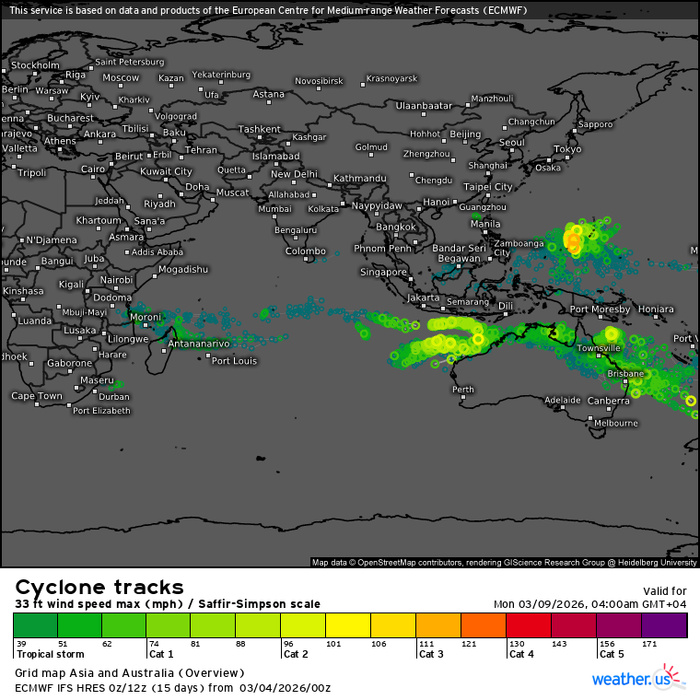
ECMWF IFS HRES MODEL RUN 03/04/2026 0000 UTC VALID FOR + 240h

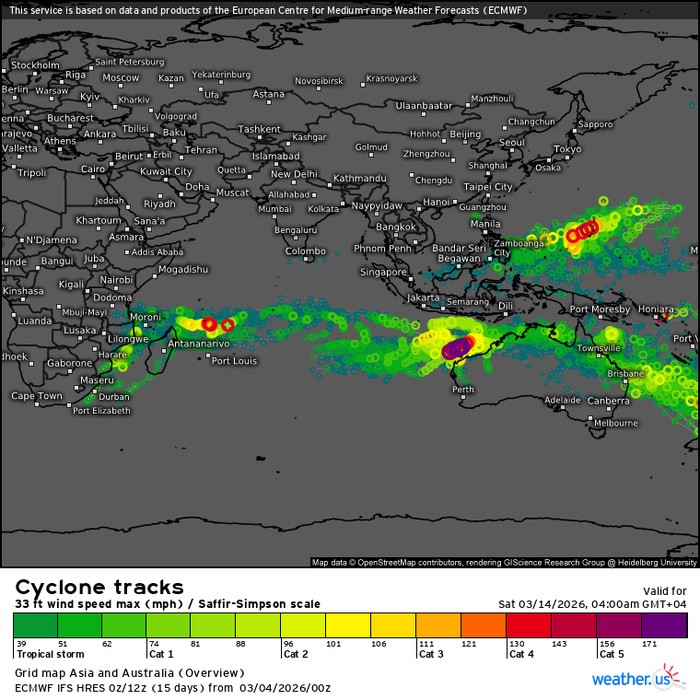
ECMWF IFS HRES MODEL RUN 03/04/2026 0000 UTC VALID FOR + 120h

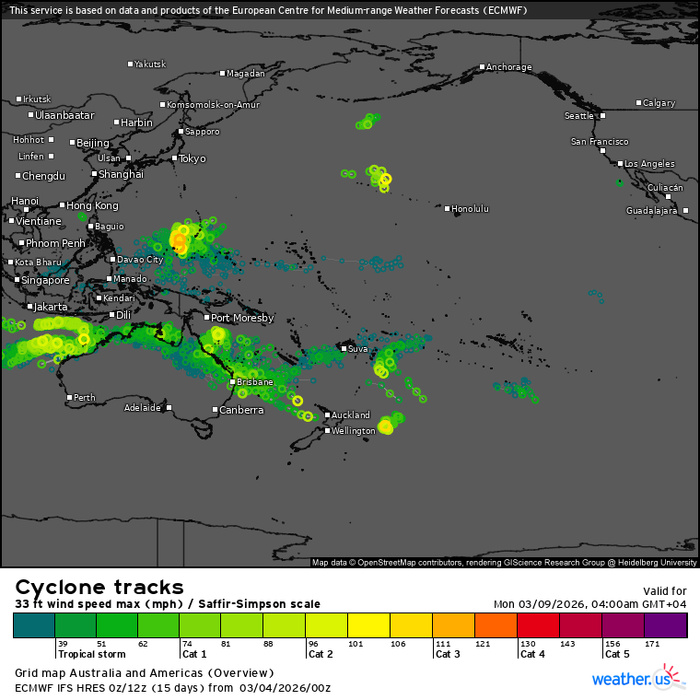
ECMWF IFS HRES MODEL RUN 03/04/2026 0000 UTC VALID FOR + 240h