

CLICK ON THE IMAGERIES BELOW TO GET THEM ENLARGED


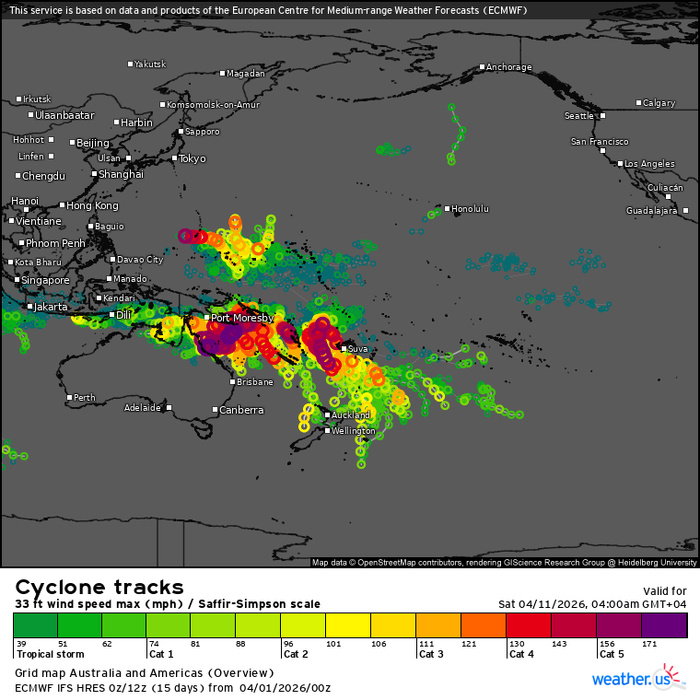
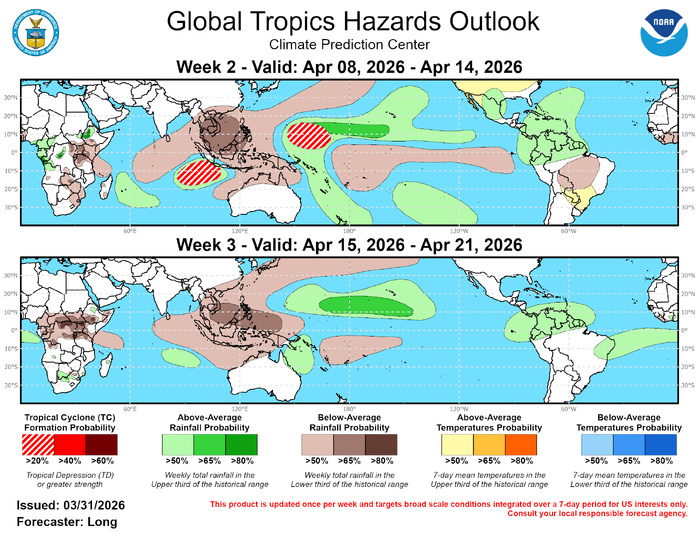
GTH Outlook Discussion Last Updated - 03/31/26 Valid - 04/08/26 - 04/21/26 Over the past two weeks, the RMM-based Madden-Julian Oscillation (MJO) signal stalled over the Western Hemisphere until recently resuming its propagation eastward and moving into Phase 1 over Africa. This stall in RMM-space can be explained by the 200-mb velocity potential and Outgoing Longwave Radiation (OLR) anomalies which show a breakdown of the wave-1 pattern into a persistent wave-2 pattern which fails to project clearly onto the RMM index. The envelope of enhanced divergence has split into two, with one pocket remaining over the central Pacific and one continuing to propagate eastward, now located over eastern Africa. Model forecasts over the next few weeks are in fairly good agreement, predicting the two pockets of enhanced divergence merging back into a wave-1 pattern as the signal over Africa continues to move eastward and meets back up with the central Pacific pocket around Week-2. The signal over the central Pacific is also strengthened by both a Kelvin wave and a westward propagating equatorial Rossby wave constructively interfering with the MJO signal during Week-2. The Kelvin wave looks to continue propagating the signal eastward in Week-3. This evolution is less clear in RMM-space, where the models have differing forecasts during Week-1, but as the wave-1 pattern re-emerges, as does the consistency between the models. The RMM-based MJO signal strengthens over the Western Pacific in Week-2 (Phase 6) and moves eastward into the Western Hemisphere in Week-3 (Phases 7 and 8). Over the past week, no new Tropical Cyclone (TC) formations occurred. However, TC Narelle continued its counter-clockwise trek around Australia. After forming on 17 March in the Coral Sea and making multiple landfalls in Northern Australia as it moved west, TC Narelle reemerged off the Kimberly coast and finally turned south as it re-intensified, making a final landfall near Learmonth on 27 March. During this coming week, the Joint Typhoon Warning Center (JTWC) is watching one area for possible TC development over the central Indian Ocean. Two other areas of possible formation include the South Pacific, from Papua New Guinea to east of the Solomon Islands, and the Western Pacific, west of the Marshall Islands. For further updates on these possible systems, please refer to the JTWC at: https://www.metoc.navy.mil/jtwc/jtwc.html . The area in the Western Pacific mentioned above, west of the Marshall Islands, has a chance for TC formation either at the end of Week-1 or at the start of Week-2. It is still hard to decipher the exact timing and therefore a 20-40% chance of development is posted for the region in Week-2. Higher probabilities would be forecasted if the timing was more certain. The strong westerly wind burst occurring in the area along with TC genesis composites for an MJO in phase 6 both support formation in the region. Models are also showing increased support for possible cyclogenesis in the eastern Indian Ocean during Week-2. The anomalous westerlies in the area have been growing stronger over the past few days in the models, and Rossby Wave activity in the area may help kick off formation, resulting in a 20-40% chance of development. By Week-3, the Southern Hemisphere quiets down significantly as we enter mid-April, the tail-end of the season for the hemisphere. In the Western Pacific, conditions may continue to support cyclogenesis with continued westerlies in the region, but model support is low and no corresponding genesis area is issued at this time.


The precipitation outlook for Weeks 2 and 3 is based on the skill weighted consolidated blend of CFSv2, GEFS, and ECMWF ensemble forecast systems and historical composites during Mar-May for MJO phases 6-8. Below-average rainfall is expected over the central Indian Ocean into the western Pacific Ocean during Week-2. By Week-3, this signal shifts slightly eastward and is more confined to the Maritime Continent. Above-normal rainfall is expected in the central Pacific, including Hawaii, and over northern South America. Increased chances for above-normal, but non-hazardous, temperatures continue over much of the United States in Week-2. For hazardous weather conditions in your area during the next two weeks, please refer to your local NWS office, the Medium Range Hazards Forecast from the Weather Prediction Center (WPC), and the CPC Week-2 Hazards Outlook. Forecasts issued over Africa are made in coordination with the International Desk at CPC.

ECMWF IFS HRES MODEL RUN 01/04/2026 0000 UTC VALID FOR + 120h

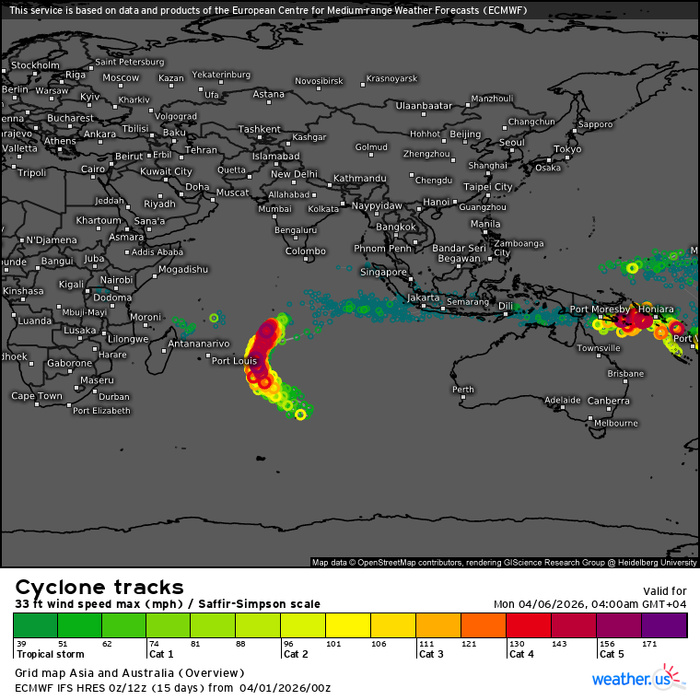
ECMWF IFS HRES MODEL RUN 01/04/2026 0000 UTC VALID FOR + 240h

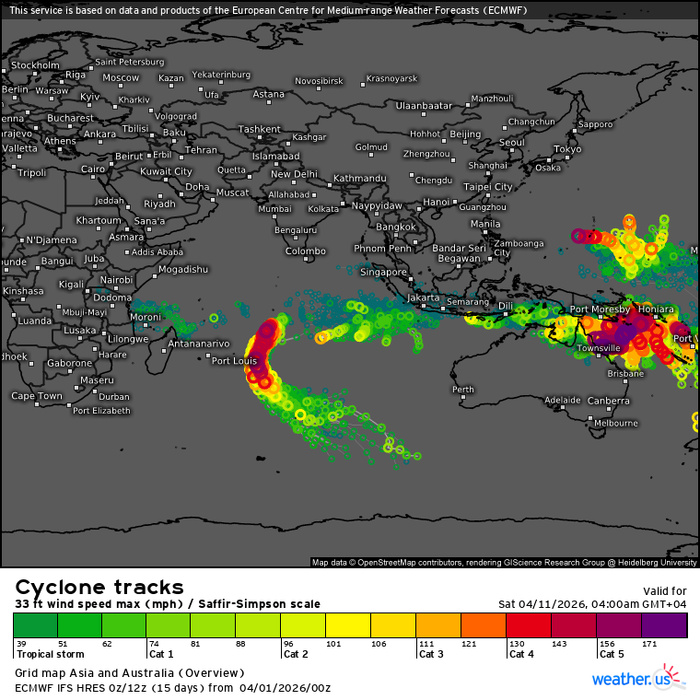
ECMWF IFS HRES MODEL RUN 01/04/2026 0000 UTC VALID FOR + 120h

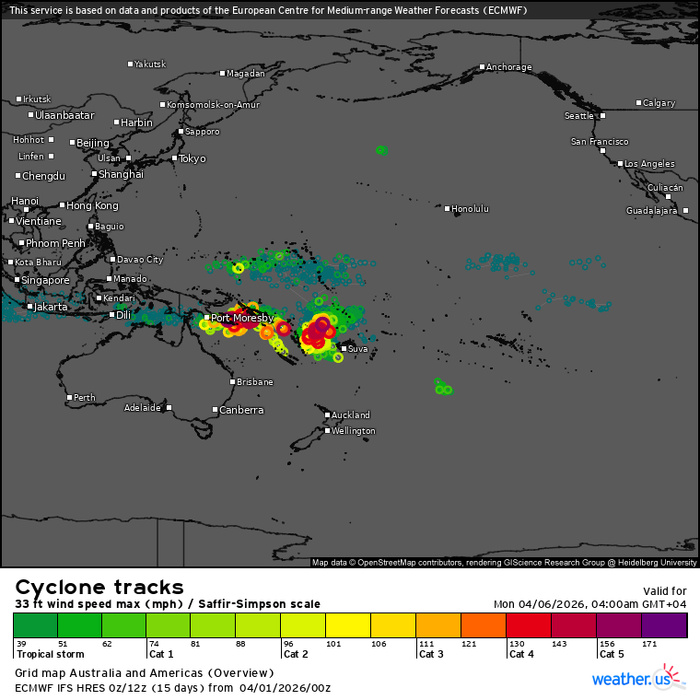
ECMWF IFS HRES MODEL RUN 01/04/2026 0000 UTC VALID FOR + 240h